

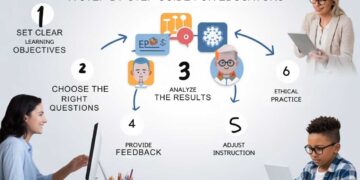




























The art of lesson planning requires balancing creativity, pedagogy, and time management.
While AI can’t replace a teacher’s intuition about their students’ needs, it can dramatically streamline the planning process.
In my own classroom, AI tools have reduced my lesson planning time from three hours to just 45 minutes per week, while actually improving the quality and differentiation of my lessons.
Immediate Implementation Strategies
Creating Your AI-Enhanced Planning Template
The foundation of effective AI-assisted lesson planning lies in crafting the right prompts. Think of these prompts as detailed instructions for your digital teaching assistant. Here’s the template I’ve refined over months of testing:
“Please help me create a detailed lesson plan with the following specifications:
- Subject: [Your subject]
- Topic: [Specific topic]
- Grade Level: [Grade]
- Duration: [Time]
- Prior Knowledge: [What students already know]
- Common misconceptions: [Areas where students typically struggle]
- Learning styles to address: [Visual, auditory, kinesthetic, etc.]
- Special considerations: [IEPs, language learners, etc.]”
This comprehensive prompt typically generates a solid foundation that you can then customize. Let’s see it in action with a real example from an 8th-grade science class:
“Please help me create a detailed lesson plan with the following specifications:
- Subject: Physical Science
- Topic: Introduction to Newton’s Laws of Motion
- Grade Level: 8th grade
- Duration: 55 minutes
- Prior Knowledge: Students understand basic force concepts and have completed a unit on motion
- Common misconceptions: Students often think objects in motion need constant force
- Learning styles: Need to incorporate visual, kinesthetic, and analytical approaches
- Special considerations: Three ESL students and two students with IEPs requiring written instructions”
The AI-generated outline serves as a starting point that you can enhance with your knowledge of your specific students and classroom dynamics.
Differentiation Made Simple
One of AI’s most powerful applications in lesson planning is creating differentiated materials. Instead of spending hours adapting content for different ability levels, use this approach:
First, generate your base lesson content: “Create an explanation of photosynthesis suitable for 7th-grade science.”
Then, use this follow-up prompt for differentiation: “Please adapt this explanation for:
- Advanced students who need deeper engagement
- Students who need additional support
- English language learners”
This process typically takes less than five minutes and provides thoughtfully differentiated content that you can further customize.
Resource Generation and Enhancement
Once you have your lesson structure, AI can help create supporting materials. Here’s my tested workflow:
- Start with your main concept and use this prompt: “Generate engaging activities to teach [concept] that incorporate multiple learning styles. Include:
- Warm-up activity
- Main lesson activities
- Assessment strategies
- Extension activities”
- For each activity, generate specific materials: “Create a graphic organizer for students to record their observations during the Newton’s Laws demonstration.”
- Develop check-for-understanding questions: “Generate progressive questions about Newton’s Laws, starting with basic recall and building to analysis and application.”
Interactive Elements and Student Engagement
AI excels at suggesting creative ways to maintain student engagement. Use this prompt structure for generating interactive elements:
“Suggest interactive activities for teaching [topic] that:
- Take 5-10 minutes each
- Require minimal materials
- Allow for whole-class participation
- Include movement or hands-on elements
- Connect to real-world applications”
Advanced Planning Strategies
Cross-Subject Integration
AI can help identify natural connections between subjects, enriching your lessons. Try this prompt:
“Identify connections between [your current topic] and other subjects (math, language arts, social studies, etc.). Suggest ways to incorporate these connections into the lesson.”
For example, when teaching about the Industrial Revolution in history, AI might suggest connections to:
- Science: Environmental impact and simple machines
- Math: Population growth and statistical analysis
- Language Arts: Literature from the period
- Art: Changes in artistic movements due to urbanization
Project-Based Learning Development
AI can help structure extended learning projects that integrate multiple skills and subjects. Use this framework:
“Help me design a project-based learning unit about [topic] that:
- Spans 2-3 weeks
- Incorporates real-world problems
- Includes multiple assessment points
- Allows for student choice
- Addresses these standards: [list standards]”
Assessment Integration
Build assessment opportunities directly into your lesson plans using this prompt structure:
“Create formative assessment strategies for [topic] that:
- Can be implemented in 5 minutes or less
- Provide immediate feedback
- Allow for quick data collection
- Address multiple learning styles
- Include both individual and group options”
Making It Your Own
Remember that AI-generated lesson plans should serve as a foundation, not a final product. Here’s my process for personalizing AI-generated content:
- Review the generated plan through the lens of your specific students’ needs
- Add your personal teaching style elements and proven strategies
- Incorporate relevant current events or student interests
- Adjust pacing based on your knowledge of your class
- Add specific modifications for your students with special needs
The goal isn’t to create a perfect lesson plan instantly, but to give you a strong foundation that you can refine with your professional expertise. This approach typically saves 60-70% of traditional planning time while improving the quality of differentiation and engagement strategies.












Comments 2